Jeremy Kirsch: What is The Wonder Tunnel? Tell us a little about the project and how it came about.
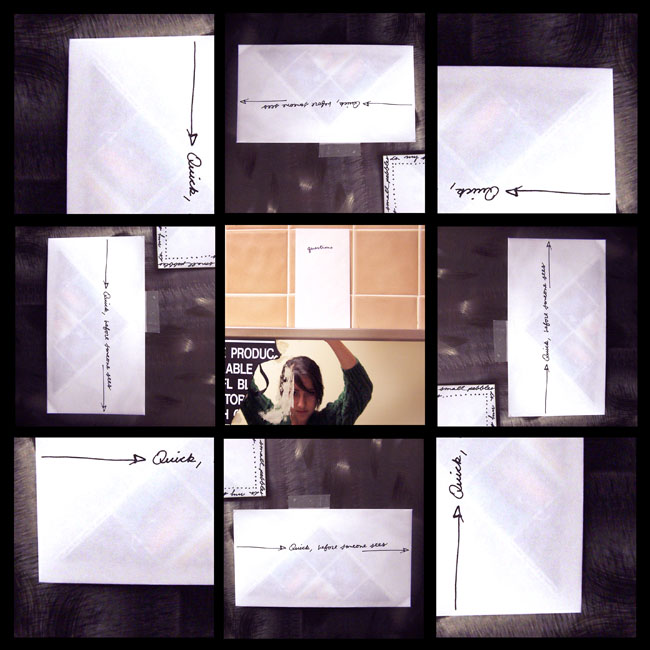
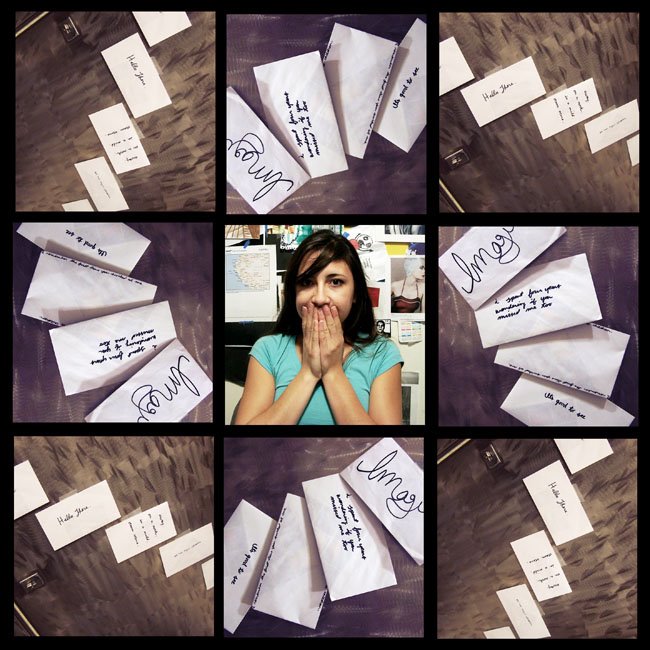
Carina Downing: I’ve been thinking about the Wonder Tunnel for a couple of years now. It actually started off as a seedling idea. I was doing weird things like leaving these envelopes in places for people to find and in the envelopes there would be photographs. I left these things in bathrooms and schools, on tables at cafes and taped them to business windows. This was all because of this wonder idea where I figured that if I were to find one of these envelopes I’d be really jazzed and excited wondering where it came from and what it was all about. So I figured other people would appreciate that too.
Later I thought about making this little box-like tunnel thing that would have hinges and would fold up and I could transport it around towns and drop it in public parks and then watch and see if people would go in it and maybe film it too. Oh, and inside there would be things on the walls to look at and things on the ceiling too, although I didn’t work through what these things would be. But I wasn’t really sure if it was a good idea and when I remembered that this would involve me having a truck to lug it around and I didn’t have a truck so I forgot about the tunnel for a while.
Then when a few months later when I went to school up in San Francisco I had an assignment to make a proposal for a public art project and this other student, Artie, and I we made a crazy proposal to get tons and tons of cardboard and essentially stitch it together and create a 12 foot wall out of it that would block a huge section of the entrance to the SF State campus and force people to either walk around it or to go through it. Of course, when you went through it you found yourself in a series of cardboard rooms which eventually led you to a “Curiosity Cocoon”. This “Curiosity Cocoon” is pretty much the Wonder Tunnel except it would have been designed as a tapering tunnel which you would eventually have to crawl out of. However we never created the cardboard fortress.
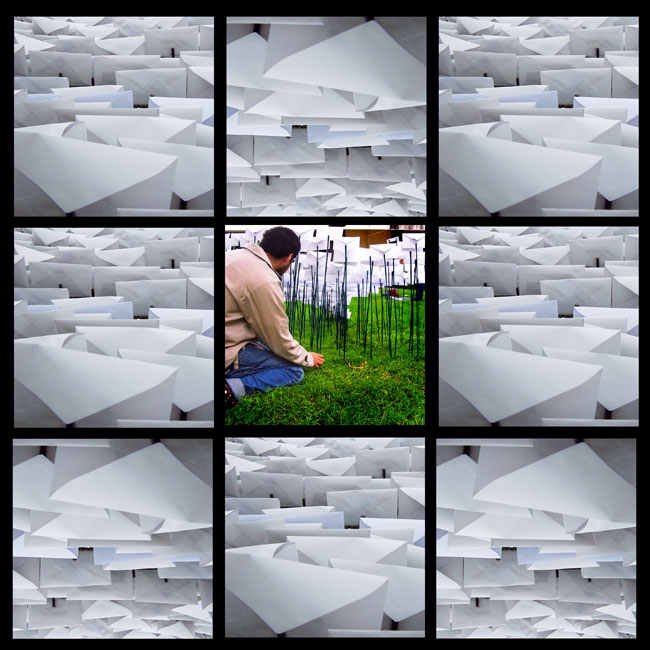
Finally, a couple of months ago when you asked me if I could make something for GO GALLERY I immediately thought of the tunnel. I forgot about the clever name “Curiosity Cocoon” and since the first thing I blurted out was Wonder Tunnel that was the name that stayed. So I decided to make it. With the help of my parents Jim and Vanessa and my sister Larissa we worked through the idea and decided to expand the tunnel to be big enough to walk through amongst many other decisions. They helped keep the idea in check in a big way.
I wanted people to be able to explore each others wonders and I’ve found many though provoking, funny, and interesting wonders in the tunnel already. The tunnel is really about people connecting with other people and being able to be comfortable with art and develop a personal connection with it. I’m not so interested in having to stay an arms length from art at all times. Some times it seems like this is art, and that is you, and stay away and don’t touch it, or mess it up. But art is really just another part of life and people should be able to form connections with it.
JK: Your work is primarily interactive and involves communication between the artist, the viewer and amongst the viewers as a group. What kind of dialog does your work create?
CD: I’ve had some great conversations with people over the Wonder Tunnel. I feel like it is really reaching out to people who aren’t necessarily gallery-goers or art students, or involved in the art community and this is really important to me because I want to make art for all people not just art for other artists to see.
I’ve had people come up to me asking where the idea came from and did I really make it up. I guess its not the most common thing, to be making art that visitors touch and add to these days and so lots of people were really excited about it. They were asking me if they could add more and what was the limit.
It was great to talk to them after they got out of the tunnel because I would ask them if they found any good ones and each person had a totally different response. One person would say, “I liked the one that said, “I wonder why Zack was friends with Screech on Saved by the Bell”. Another person would say, “I like the one that said,” I wonder what its like to be blind”. And another person would say, “The best one was the one that said, ” I wonder what its like to dance at your own wedding”
Each of these wonders was so different and so were the people that were contributing to the tunnel. It was like a buffet, everyone could find something they liked.
I got a lot of people who admitted that for the most part they didn’t really “get” art but that they actually liked the tunnel, which was really great that they could relate to it. People were saying that they really enjoyed the interactivity.
JK: You are active not only as a conceptual artist, but as a visual artist, musician and video producer. Talk to us a little about these projects. As an artist, what role can an artist have in bettering the local community?
CD: Mmm… I really can’t make up my mind that’s all…
Well as far as visual arts go I’m a photography major at Cal State Long Beach right now so I do photography a lot, hence the photography on the walls in the gallery right now. I really like photography but I find it difficult to really create a dialog with just photographs so that’s what makes me do conceptual art and then document that art with photos.
It seems like most people just see the picture, keep on walking, see the next picture, keep on walking, and say “well that’s interesting” and then leave the gallery. I’m not so interested in the conversation ending with, “well that’s interesting” so I try to make things hands-on engaging whenever possible.
As far as music goes, I love playing it. I’ve been doing something music related for since I was a child but have only been writing my own songs for about five years. My song writing process is extremely slow though, so even after five years I only have about five songs that I’ve kept and perform live nowadays. Besides my solo stuff I’ve written a few songs with Pam Gartner and Jose Serna but those are recorded and we’ve made them complicated enough where were still trying to figure out how to perform them live. So that’s in the works still.
And now for the videos. I have a few that are documentation of public art projects. There are a couple videos I’ve participated in with collaboration. We did these Lunchtime Limbo interventions where we went into San Francisco with a ton of Hawaiian leis, a boombox blasting limbo songs, and a limbo stick and tried to get people downtown to do the limbo at noon. It worked out so well in San Francisco that we did it in Ventura the next year however the response was much less enthusiastic. I also made a short movie called Charlatan in 2005 that was about the way that people sometimes treat television like a replacement for people. It showed a few satirical scenes in which television just wasn’t measuring up to being like a human.
Besides those videos I also co-founded a music and arts production group called Songs from a Window with Jose Serna. We do a online/public access TV show where we feature local musicians and do performance footage and an interview segment as well. These have been really fun and a super learning experience.
How can artists better the community eh?
Well first off I want to clear it up that I have a weird idea about artists. Really I feel like I just happen to really want to make visual things, and interactive things, and music things and that I feel pretty comfortable doing this so you might say that its a talent. But the thing is that really everyone has a talent and its not necessarily making something visual or music but it may be that they are really patient, or that they can fix faucets super well, or that they can make quilts.
So really I think that being an artist is just taking what you can do and doing it and then offering it up for other people. So musicians can make their music and people will enjoy it, and faucet fixers will help fix faucets and people will benefit, and patient people will keep their patience and that will be their contribution but as long as you acknowledge that you can do something well and then you do it, you will be helping with whatever that thing you do well is. I don’t want to sound like I’m just saying “oh I’m so talented”. Thats not what its about, but I think that if people did use their talents more often and offer their talents up to others that that is the best contribution to the community.
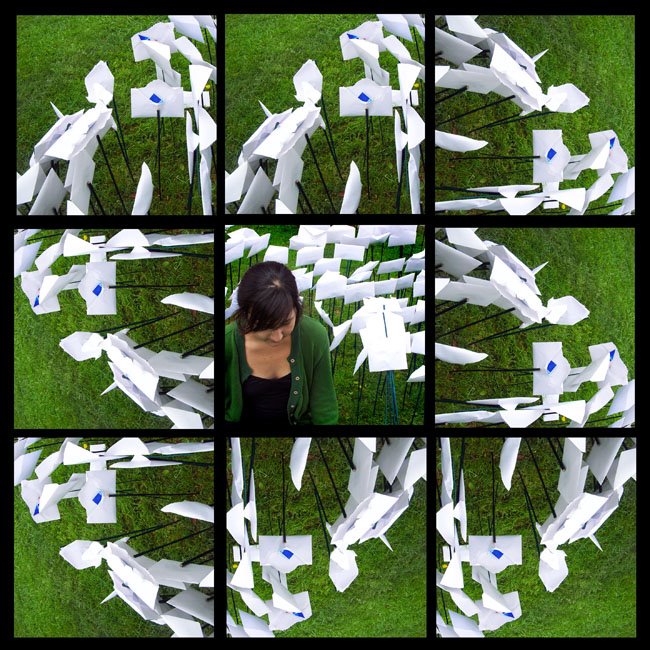
So I want to thank the people who did that just within this wonder tunnel show, you Jeremy got the hype up with your graphic design skills by making the postcard announcement look so professional, the musicians all came a played for free because they enjoy it and want others to enjoy it to, my family all used their separate talents to help me create the wonder tunnel. My dad helped with the construction, my mom the decoration, my sister, and Jose helped put up the hundreds of envelopes. And my mom used her awesome food skills to provide some delicious foods.
And it all came together to create one great night, where a bunch of nice people who didn’t all know each other all got together to talk and see and listen and that community vibe was going strong.
JK: What do you want to be when you grow up?
CD: When am I considered grown up? Um, it feels strange to plan things that are so far away in both time and in how much I have to learn before I can do this but I’d like to continue making things like art and music and then also sometime after I get my BFA and MFA I’m going to become a photography professor at a community college.
http://cphotography.blogspot.com
http://myspace.com/songsfromawindow